1. Estimate sales
Attendance × conversion rate estimates buyers. Buyers × items per customer estimates the number of products sold.
Estimate craft fair revenue, product costs, event expenses, break-even sales, and potential profit before you commit to the booth. No account required.
A busy market can still disappoint if product costs and event expenses eat up too much of your sales. This calculator helps you look at the money left after those costs.
Use your best estimates. Change any number and the results update instantly.
Based on your expected sales and costs.
This estimate suggests the event could cover your listed costs, but compare the upside with the time and inventory required before booking.
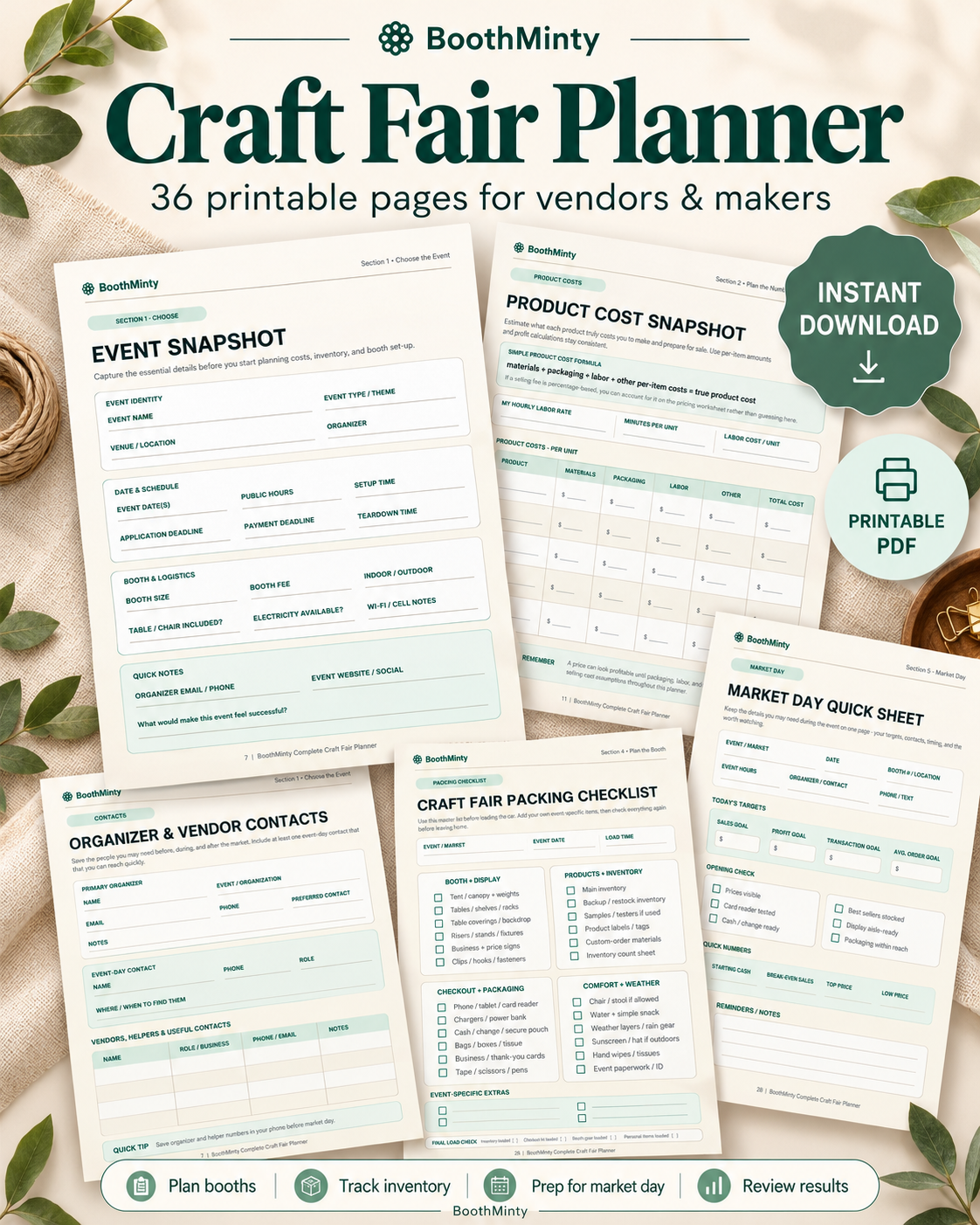
Use this free calculator for quick numbers. Then keep your event budget, prices, inventory, booth setup, and sales results together in the 36-page printable planner.
All BoothMinty online calculators remain free.
Attendance × conversion rate estimates buyers. Buyers × items per customer estimates the number of products sold.
Your product cost is multiplied by the estimated units sold so you can see the cost of the inventory used to generate those sales.
Booth fees, travel, parking, food, and other event costs are deducted to estimate the profit left after the event.
Use the same basic math BoothMinty applies to your estimates so you can see where the final profit number comes from.
Estimated revenue = expected buyers × items per customer × average selling price.
Product costs = estimated items sold × average product cost.
Estimated event profit = estimated revenue − product costs − booth, travel, parking, food, and other event costs.
Suppose 50 shoppers buy an average of 1.2 items at $25 each. That is about $1,500 in revenue. If 60 items cost $8 each to make, product costs are $480. If the booth fee and other event costs total $250, estimated profit is $770 before taxes and any business overhead not entered in the calculator.
Two events can produce similar sales but very different profit once booth fees, travel, product costs, and other expenses are included. Comparing the same inputs for each event makes it easier to judge which opportunities deserve your time and inventory.
See how revenue, product costs, event expenses, payment fees, profit margin, time, and scenario planning fit together before you judge an event by sales alone.
The full BoothMinty event planner also helps with recommended inventory, packing, cash for change, and multiple event-performance scenarios.
Estimate your event revenue, subtract the cost of the products sold, then subtract fixed event expenses such as booth fees, travel, parking, food, and other costs. BoothMinty calculates these amounts from the estimates you enter.
Break-even depends on your event expenses and how much money each product contributes after its product cost. Use the craft fair sales goal calculator when you also want to include a specific profit target and sales pace.
Include your booth fee, travel, parking, food, and other event-specific costs, plus the cost of the products you expect to sell. If you have payment-processing fees or other costs that materially affect the event, include them in your other costs.
There is no single margin that fits every maker. Product category, labor, overhead, unsold inventory, taxes, and business goals all matter. Use the calculator to compare events consistently rather than relying on one universal target.
No. BoothMinty provides planning estimates based on the information you enter. Actual attendance, buyer behavior, weather, event quality, sales, and costs can differ.